
Evidence-Based Statistics (Peter M. B. Cahusac). - Скачать | Читать к…
페이지 정보

본문
Представляем для скачивания и чтения книгу Evidence-Based Statistics от известного автора Peter M. B. Cahusac.
Произведение -го года.
Скачать книгу »
Читать онлайн »
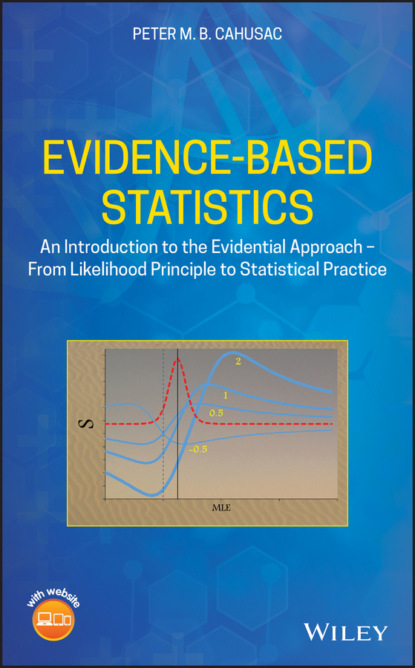
Evidence-Based Statistics: An Introduction to the Evidential Approach – from Likelihood Principle to Statistical Practice provides readers with a comprehensive and thorough guide to the evidential approach in statistics. The approach uses likelihood ratios, rather than the probabilities used by other statistical inference approaches. The evidential approach is conceptually easier to grasp, and the calculations more straightforward to perform. This book explains how to express data in terms of the strength of statistical evidence for competing hypotheses. The evidential approach is currently underused, despite its mathematical precision and statistical validity. Evidence-Based Statistics is an accessible and practical text filled with examples, illustrations and exercises. Additionally, the companion website complements and expands on the information contained in the book. While the evidential approach is unlikely to replace probability-based methods of statistical inference, it provides a useful addition to any statistician’s "bag of tricks." In this book: It explains how to calculate statistical evidence for commonly used analyses, in a step-by-step fashion Analyses include: t tests, ANOVA (one-way, factorial, between- and within-participants, mixed), categorical analyses (binomial, Poisson, McNemar, rate ratio, odds ratio, data that’s ‘too good to be true’, multi-way tables), correlation, regression and nonparametric analyses (one sample, related samples, independent samples, multiple independent samples, permutation and bootstraps) Equations are given for all analyses, and R statistical code provided for many of the analyses Sample size calculations for evidential probabilities of misleading and weak evidence are explained Useful techniques, like Matthews’s critical prior interval, Goodman’s Bayes factor, and Armitage’s stopping rule are described Recommended for undergraduate and graduate students in any field that relies heavily on statistical analysis, as well as active researchers and professionals in those fields, Evidence-Based Statistics: An Introduction to the Evidential Approach – from Likelihood Principle to Statistical Practice belongs on the bookshelf of anyone who wants to amplify and empower their approach to statistical analysis.
Скачать книгу »
Читать онлайн »
If you have just about any concerns regarding exactly where and also the best way to make use of Wmlogs, you possibly can e-mail us from our web site.
Произведение -го года.
Скачать книгу »
Читать онлайн »
Evidence-Based Statistics: An Introduction to the Evidential Approach – from Likelihood Principle to Statistical Practice provides readers with a comprehensive and thorough guide to the evidential approach in statistics. The approach uses likelihood ratios, rather than the probabilities used by other statistical inference approaches. The evidential approach is conceptually easier to grasp, and the calculations more straightforward to perform. This book explains how to express data in terms of the strength of statistical evidence for competing hypotheses. The evidential approach is currently underused, despite its mathematical precision and statistical validity. Evidence-Based Statistics is an accessible and practical text filled with examples, illustrations and exercises. Additionally, the companion website complements and expands on the information contained in the book. While the evidential approach is unlikely to replace probability-based methods of statistical inference, it provides a useful addition to any statistician’s "bag of tricks." In this book: It explains how to calculate statistical evidence for commonly used analyses, in a step-by-step fashion Analyses include: t tests, ANOVA (one-way, factorial, between- and within-participants, mixed), categorical analyses (binomial, Poisson, McNemar, rate ratio, odds ratio, data that’s ‘too good to be true’, multi-way tables), correlation, regression and nonparametric analyses (one sample, related samples, independent samples, multiple independent samples, permutation and bootstraps) Equations are given for all analyses, and R statistical code provided for many of the analyses Sample size calculations for evidential probabilities of misleading and weak evidence are explained Useful techniques, like Matthews’s critical prior interval, Goodman’s Bayes factor, and Armitage’s stopping rule are described Recommended for undergraduate and graduate students in any field that relies heavily on statistical analysis, as well as active researchers and professionals in those fields, Evidence-Based Statistics: An Introduction to the Evidential Approach – from Likelihood Principle to Statistical Practice belongs on the bookshelf of anyone who wants to amplify and empower their approach to statistical analysis.
Скачать книгу »
Читать онлайн »
If you have just about any concerns regarding exactly where and also the best way to make use of Wmlogs, you possibly can e-mail us from our web site.
- 이전글Home Security Checklist 24.01.05
- 다음글Turning Very Popular Books Into Films 24.01.05
댓글목록
등록된 댓글이 없습니다.